
We need stories. Thanks to them we can shape and understand what happens around us – or escape our reality, in case we do not like what surrounds us. Stories give us access to people we will never meet, lives we will never have, worlds we will never visit. Stories make our minds grow and our lives better. We might never know what was the very first tale ever created, but we know that we will keep telling each other stories many years into the future.
The more stories you learn, the more chances you have to start seeing how some of them share similar patterns, characteristics that connect them – after all, we make stories up, and it would be impossible to invent a tale that is completely, one hundred percent unique. The task of studying narratives and how they impact (and are shaped by) our existence is the responsibility of narratologists, like the one portrayed by Tilda Swinton in Three Thousand Years of Longing, film in which her character finds a bottle containing a Djinn -played by Idris Elba-, who, after having been set free, grants her three wishes. So far the story does not seem that new, but not everything is as it seems in the latest film directed by George Miller (who also co-wrote the script with Augusta Gore), based on A.S. Byatt’s short story The Djinn in the Nightingale’s Eye.

Considering this is a film in which said narratologist and the Djinn find themselves in a hotel room telling stories, discussing their importance and significance in our existence, it was obvious that narrations were going to be the backbone of Three Thousand Years of Longing. However, the film does not remain motionless in the room with the two central characters. Had they spent more time with Swinton and Elba there, telling stories to each other, we would have recreated some elements of those tales in our minds to fill in the gaps in the Djinn’s narration, and whilst this would have reinforced the connection between the stories and us, the film might have been closer to a play, smaller and less visually enthralling.
As he has done before in his eclectic career (in which, taking aside the Mad Max franchise, we also find Babe, The Witches of Eastwick, and Happy Feet, to name a few and completely different projects), Miller has created a unique film that feels his own from beginning to end, made with such a high degree of originality and attention to detail that brought to my mind the work of Guillermo del Toro, another director with a unique sensibility and style. The result of Miller’s work is a visually masterful and mesmerizingly beautiful film that plenty of times will make us sit with our eyes wide opened, gazing at what is going on in the screen. Though its use undercuts our imagination by showing us everything that Elba’s Djinn narrates, CGI has been used in a way that does not feel too intrusive, but suited to the fanciful nature of the film.
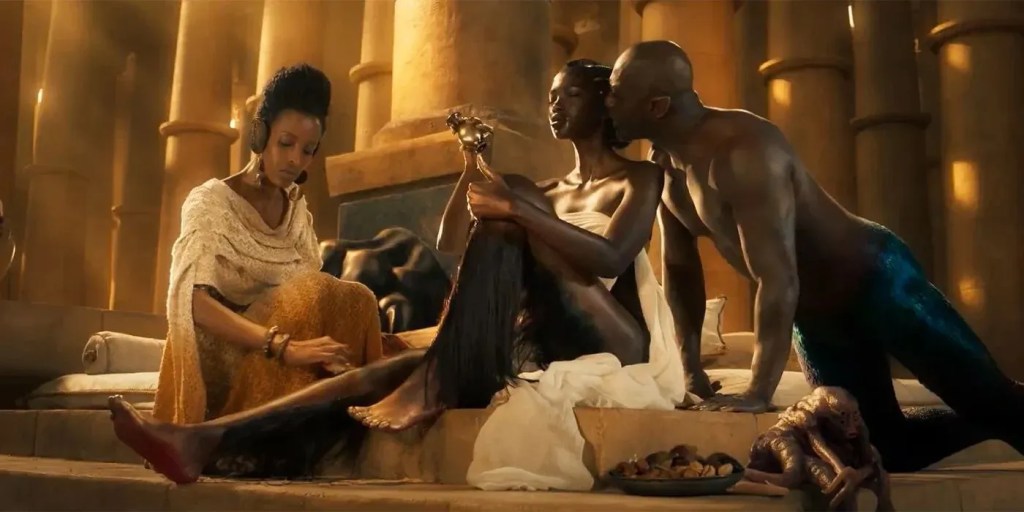
In a similar way to what happened with his latest entry in the Mad Max franchise, the scale of the film does not overshadow the performances of the cast. Although Swinton and Elba have been better in other films (in this one yes, not in this one, though), here they both play well off of each other, revealing new layers of their characters as the story progresses, never reducing their roles to mere clichés, allowing us to believe them in their roles, which is necessary for us to maintain interest in the more perfunctory parts of the script.
One of the biggest qualms I find with Three Thousand Years of Longing is that despite its ambition in terms of scale, and its interest on dealing with issues like the quest for knowledge, human evolution, love, and having to survive on our own (as it is beautifully put in the film: “I want our solitudes to be together”), it clocks in at less than 110 minutes. Surely, the film might have benefitted from a longer runtime, though its short length is not itself the main issue here, as the rhythm is slow at times, and the film repetitive, going from Swinton and Elba in the room to seeing the stories taking shape, again and again and again with less cohesion and fluidity than one might expect – a bigger problem when you see that for a film built around the idea of the power of stories, it does struggle a bit to build up enough momentum to move its plot in a swift way.
Perhaps as a result of fear from the studio to make an extremely dense film, I hope we get to see a Director’s Cut in which the whole film can feel a bit more cohesive and rounded instead of cramped and clunky (problems present not only here, but sometimes typical of omnibus films). Nevertheless, Three Thousand Years of Longing -which, keep in mind is neither a sequel, nor a prequel; neither a remake, nor a reboot- is as beautiful and ambitious as it is possibly divisive, and it is another demonstration of Miller’s unique talent and originality behind the camera.

 The Neurotic Cinephile
You must be logged in to post a comment.