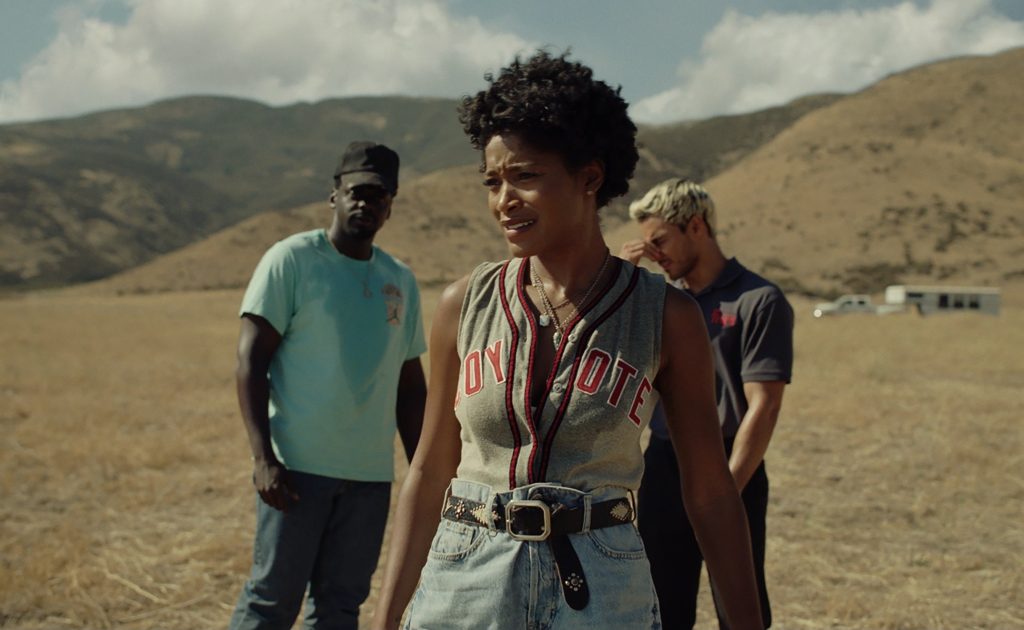
There are quite a few things to unravel in Jordan Peele’s ambitious yet divisive Nope, so in order to start, let us begin discussing the story, which centres on Daniel Kaluuya and Keke Palmer, siblings in charge of a company that rents horses to film productions. They are struggling with the business, and to make matters worse, their father (played by Keith David) unexpectedly dies when a piece of debris falls from the sky. One night, after a power outage, they see mysterious shapes moving around the clouds, discovery which leads them to think they have found something unexplainable they can exploit in order to change their lives forever.
Up to this point, one can draw parallelisms between Nope and Close Encounters of the Third Kind. To a certain extent it is true that both films share some similarities (which I will not discuss further in order to avoid spoilers), and the connection between them is extremely fitting (beyond Peele’s admiration for Steven Spielberg), considering this is -in terms of scale- Peele’s biggest film so far. Thanks to the cinematography by Hoyte Van Hoytema, Nope is a joy to watch, from the sense of scale that makes us experience the vast emptiness of the land, to the wonderful night shots that are never unclear or blurry, showing us exactly what is happening in a way that has not been done before. We are constantly aware of what is going on around us, what is happening above our heads, way out there in the sky – even at night-time… although that might be a problem for those with nephophobia (fear of clouds).
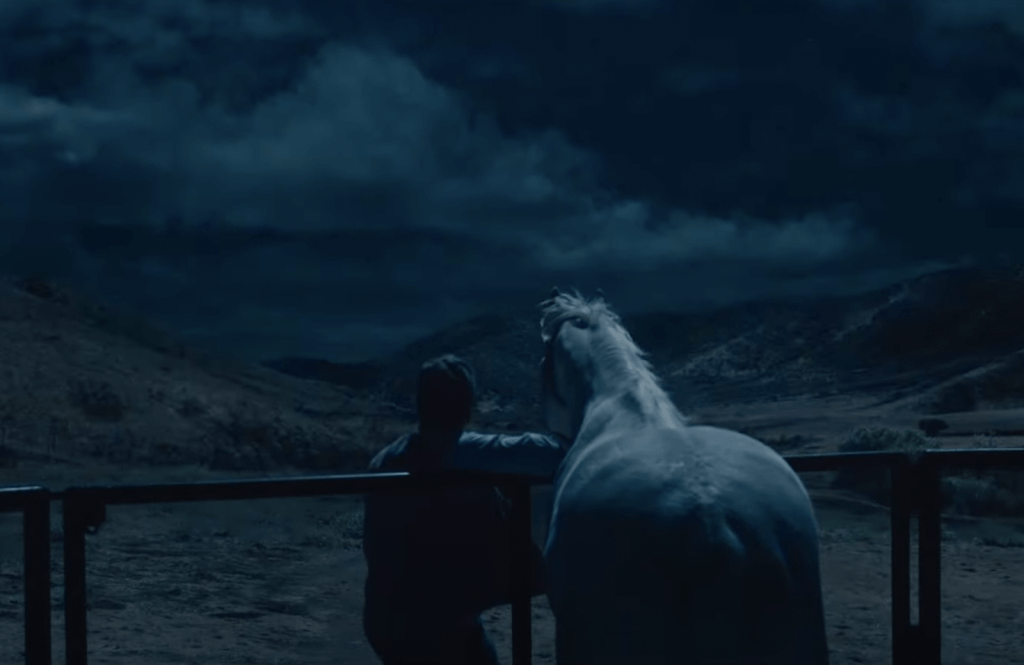
So far, Nope could have been a sci-fi film that is mesmerizing to see and that in a certain way pays homage to one of Spielberg’s most notable films. However, the filmuses its characters’ quest to contact and record the mysterious forces that surround and haunt them as an analysis on society’s inability to take our eyes off the tragic events, and, if that was not enough, our capacity to seek out profit from a tragedy. Peele clearly points it out, when in the credits he adds the following quote from The Bible: “I will cast abominable filth at you, make you vile, and make you a spectacle.” (Nahum 3:6). Watching Nope is easy to feel identified with our obsession with spectacle, and, to further demonstrate its point, the film is filled with moments in which we watch as the characters fall victims of their own idiosyncrasies, or how they reflect on the way in which a tragedy is exploited by the media – e.g., the reference to how SNL parodied what happened with Gordy (a chimp and co-star of a show starring child actor, later played by Steven Yeun). Nevertheless, the film does not present this topic, then offers a critique on its impact, thus providing a remedy, as the central characters go beyond their limitations to get what they call the Oprah shot.
Furthermore, given that Nope is a film that takes place within the confines of the Hollywood industry, Peele’s script also has the depth to study how the contributions of black artists have been relegated to the margins of culture, sometimes even ignored altogether, demonstrated by the speech Palmer’s character gives about how her great, great, great grandfather was the jockey in Eadweard Muybridge’s The Horse in Motion, the very first assembly of photographs put together to resemble a motion picture. Here, as it sadly happens in real life, black artists are still fighting to get a seat at the table, and Hollywood has to adapt and change (I wish I could say before it is too late, but I fear many years have passed and, albeit there is still time to put a remedy to this, more things should change in this dog-eat-dog industry).
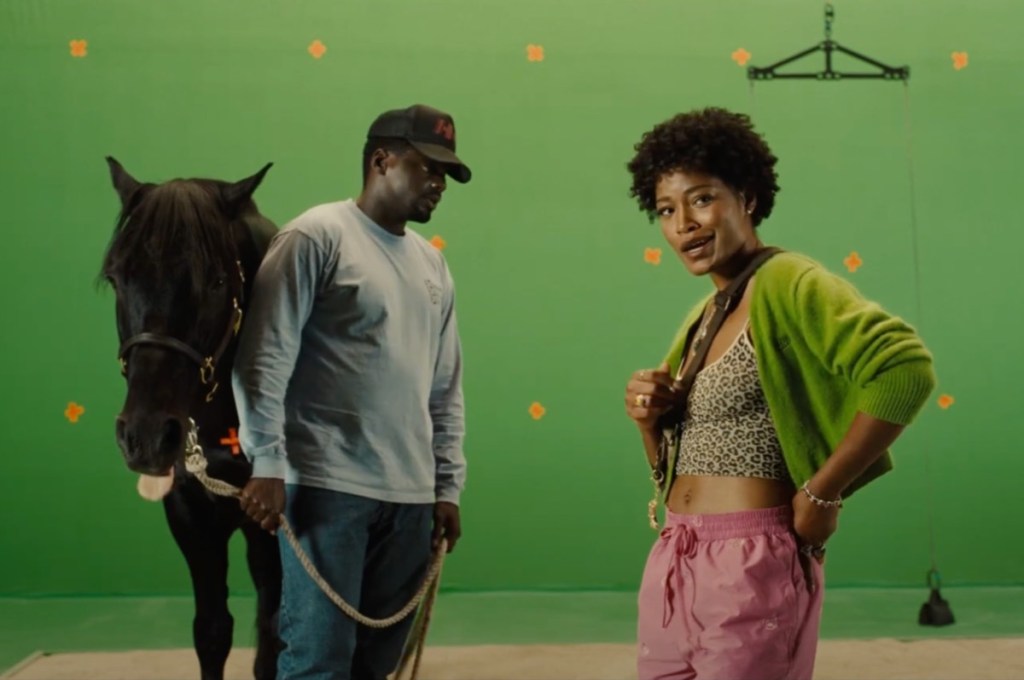
It would be impossible to finish without mentioning the central performances. In his second collaboration with Peele (they worked together in Get Out), Kaluuya completely owns the film. Proving once more how good of an actor he is, plenty of times he says everything that has to be said only with his eyes, using the silence to embody a taciturn character, a man who seems to be carrying the weight of the world on his shoulders. His behaviour and more serious personality are completely opposite to those of his sister (Palmer). Palmer’s job here is also central for the film to work, given how she is the more relatable, energetic and humorous character of the two; and whilst Kaluuya’s role is the one that glues the film together, Palmer’s character is a welcome link between the audience and the actual film. Though slightly underused, Yeun does a good job as a former child actor who still clings on to his past fame and popularity to his advantage, and, last but not least, Michael Wincott and Brandon Perea, in smaller roles, have a few scenes to shine too. It would be unfair to leave behind Terry Notary whose job capturing the movement of the chimp Gordy is outstandingly terrifying and realistic in equal measure.
Although not everything in Nope is perfect (it might not be a film for everybody, it could have benefitted from a shorter runtime, and it loses steam before, luckily, ending on a high point), it is a love letter to cinema, in which Peele not only succeeds on handling difficult themes, but he also succeeds on his attempt to pay homage to old-school blockbusters. A highly intelligent sci-fi film that updates the pattern, setting up the guidelines for how upcoming tentpoles should be like. In addition, as it happened with Get Out and Us (and also to a certain extent to his Candyman remake, although he only produced that film), it will make you excited to see what will come next in Peele’s career.

 The Neurotic Cinephile
You must be logged in to post a comment.