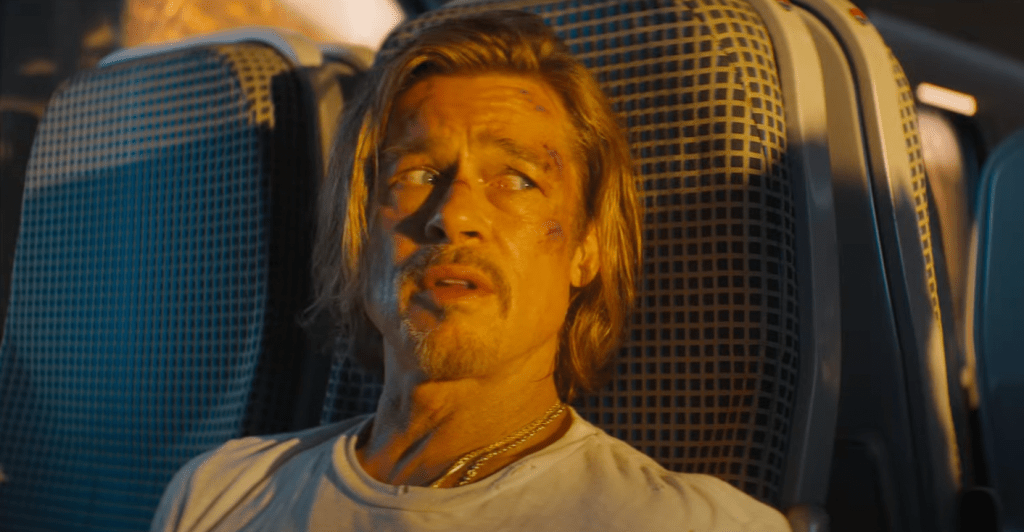
After watching Bullet Train, I found it more difficult than usual to pick up a point to start reviewing it, as I felt as if I had been on a long and eventful, yet familiar trip to a humdrum destination, with a mellow yellow passenger sitting next to me.
Obviously, I could start by describing its plot.
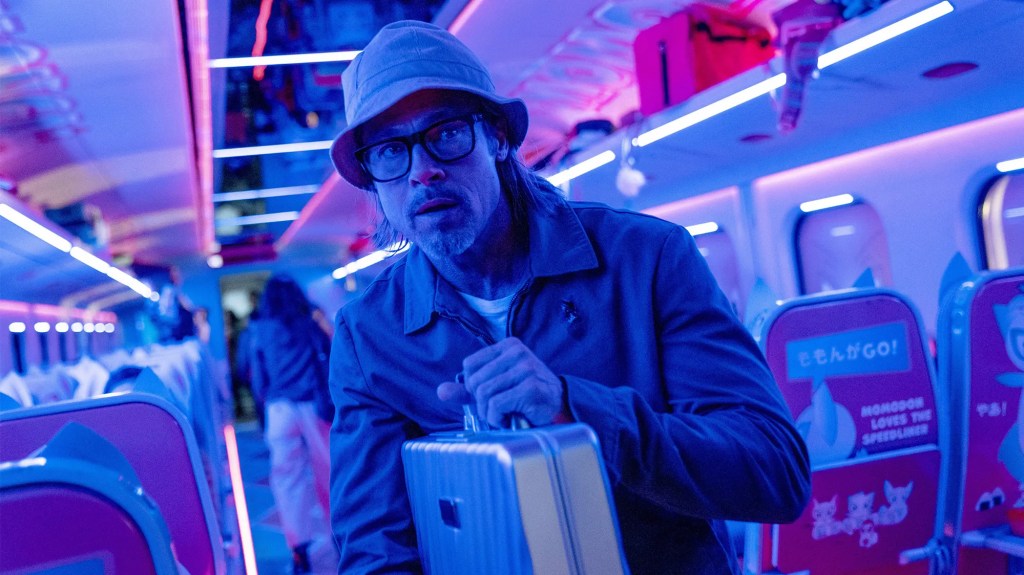
Centred on a hitman called Ladybug -played by Brad Pitt- who, given his bad luck and the fact that he is tired of killing people for a living, reluctantly accepts the simple job of collecting a MacGuffin, sorry, a suitcase from a train. So far, so good.
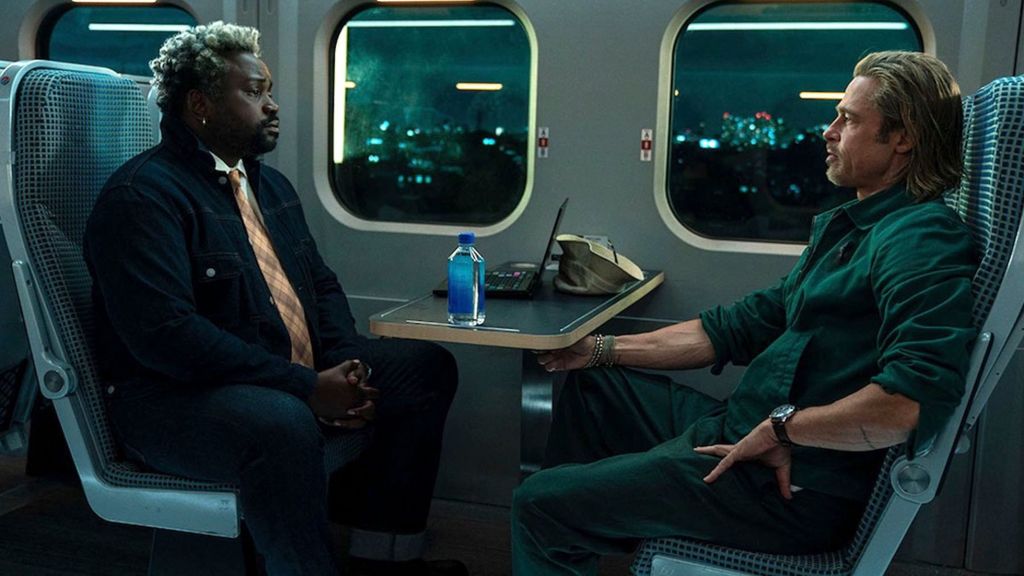
Once he gets on the train, we discover he is not the only assassin on board, as Ladybug encounters a pair of British brothers known as Lemon and Tangerine (played by Bryan Tyree-Henry and Aaron Taylor-Johnson, respectively), The Prince (Joey King), The Wolf (Bad Bunny aka Benito A. Martínez Ocasio) and The Hornet (Zazie Beetz). Throw in fights, CGI scenes of characters clinging to the side of a speedy train, a few jokes (some good, some not so much), constant back and forth between characters that brings to mind other gangster/action films, far too many references to Thomas the Tank Engine, and you get Bullet Train.
At this point I discovered two things. First, that to become an assassin these days you need to have a catchy nickname, so if I ever decided to change careers, I would choose to be called Jabberwocky, just because. Also, I discovered that for a film in which neither Guy Ritchie nor Quentin Tarantino have been involved, their influence is everywhere (with a bit of Joe Carnahan’s Smokin’ Aces thrown in for good measure), which is not necessarily a good thing.
Given how many action films are released on a yearly basis, it is not as easy to come across a good one these days. Most of them seem designed by IKEA (ahem The Gray Man, ahem Red Notice), some others (yes, The Fast and Furious saga, I am thinking about you) are so over the top that you will not be surprised if a superhero appeared in the third act. Some others are simply perfunctory, bad or forgettable (e.g., pretty much anything that involves Liam Neeson trying to avenge his wife, daughter or toaster, or The Hitman’s Bodyguard and its sequel The Hitman’s Bodyguard’s Wife’s Lover’s Thief’s Beige Rover 75… or something like that). Yes, obviously, there are wonderful exceptions. Any Mission Impossible -or any Tom Cruise vehicle for that matter- and James Bond entry will surely do the trick, and also others such as the John Wick saga, and Atomic Blonde are some of the best and most engaging actioners to come out in the last decade or so.
Curiously enough, David Leitch (former stunt double of Pitt), who happens to be the director of Bullet Train, was the director of both Atomic Blonde and co-director (albeit uncredited) of the first John Wick film. However, he was also the director of Deadpool 2, and of (the ridiculously titled) Fast and Furious: Hobbs and Shaw. Sadly, Bullet Train is closer to his last two features, as it feels like Leitch is doing here a more generic and crowd-pleasing job; a product that is attractive on the surface, and fulfils its promise to entertain, but a derivative and bland product, nonetheless.
Having started life as a novel written by Kōtarō Isaka, Bullet Train had a long road to become the film it has turned out to be, as it was initially developed by Antoine Fuqua to be an R-rated thriller, closer in spirit to films like Die Hard. Evidently, things have changed (also key characters have been whitewashed in the process), and -with Fuqua still involved as a producer-, the film became the action comedy we can now see in screens everywhere – but that would not look too out of place in Netflix back catalogue, right next to the aforementioned Red Notice or The Gray Man.
This less-than-ideal origin story is surely the reason why Bullet Train feels disjointed, failing on its attempt to please at the same time the desires of fans of actioners, comedies, gangster films, and of Pitt himself -the only ones that will feel a greater sense of satisfaction -. By juggling too many different styles and genres together with a script too influenced by Ritchie and Tarantino to be smart, the film never has a specific tone in particular, and, despite its best efforts, it ends up being neither a good thriller with a few comedic moments, nor a good comedy with a lot of action. Furthermore, although the cameos are funny, they are a wink short of demolishing the fourth wall.
Perhaps, the R-rated version of Bullet Train we never got to see would have been better. Perhaps not. We will never know. What we know is that Leitch’s Bullet Train is held together by Pitt’s performance of a seasoned, yet clueless assassin that no matter how tough the going gets, he will always land on his feet. Although he does not carry the whole weight of the film on his shoulders, as both Tyree-Henry and Taylor-Johnson do quite a bit of heavy lifting here, Pitt’s charm allows him to have fun and, effortlessly steal the film from anybody around him in a role that combines his cameo in The Lost City with his Cliff Booth from Once Upon a Time… in Hollywood.
So, with Ladybug’s positive approach to life, buckle up and try to get the most enjoyment of a film that does whatever is necessary to keep you entertained, with more or less success, as in Bullet Train the destination is not as important as the time it takes to get there, mostly because you are headed to a place you have already visited umpteenth times before.


You must be logged in to post a comment.