
“Hollywood is a place where they’ll pay you a thousand dollars for a kiss and fifty cents for your soul”
This quote, which perfectly captures one of the central themes of Andrew Dominik’s Blonde, was allegedly said by Marilyn Monroe, and the fact that I am not able to guarantee one hundred percent if she did utter that sentence connects perfectly with the idea that we think we know her, but we do not actually know the real person behind the name – and no, I am not referring to Norma Jeane, her real name, I am talking about the real events that actually happened before her life ended in a tragic and sudden way.
Dominik’s film -he is also the author of the script- is by no means the definitive biopic of Monroe’s life, as it is based on a novel of the same title by Joyce Carol Oates, who insisted that her work should not be interpreted as a biography. Starting back when Monroe was still a child living with her abusive mother (played superbly by Julianne Nicholson), the story delves into several crucial moments in Monroe’s life – such as her relationship with the sons of Charlie Chaplin and Edward G. Robinson, her romances with Joe DiMaggio (Bobby Cannavale), Arthur Miller (Adrien Brody), her encounters with -a rocket aficionado- JFK, and, of course, the ups and downs of her career.
Embodying Monroe’s charm, way of moving, and charisma, Ana de Armas owns the film through and through. Whether you like Blonde or not, there is no denying to the fact that this is her film. Turning in an Oscar worthy performance, de Armas’ transformation and dedication to her role is so deep (the scene in front of the mirror as she invokes Marilyn will haunt you way after you finish watching the film), it will make you wonder whether you are actually seeing Cuban actress inserted on some scenes of films like Some Like It Hot, or the real Monroe herself. By far the best thing of the film, de Armas is fully committed to the performance, never losing grip of the real person she is portraying -not imitating-, even though the film has reduced its protagonist to the bare minimum.
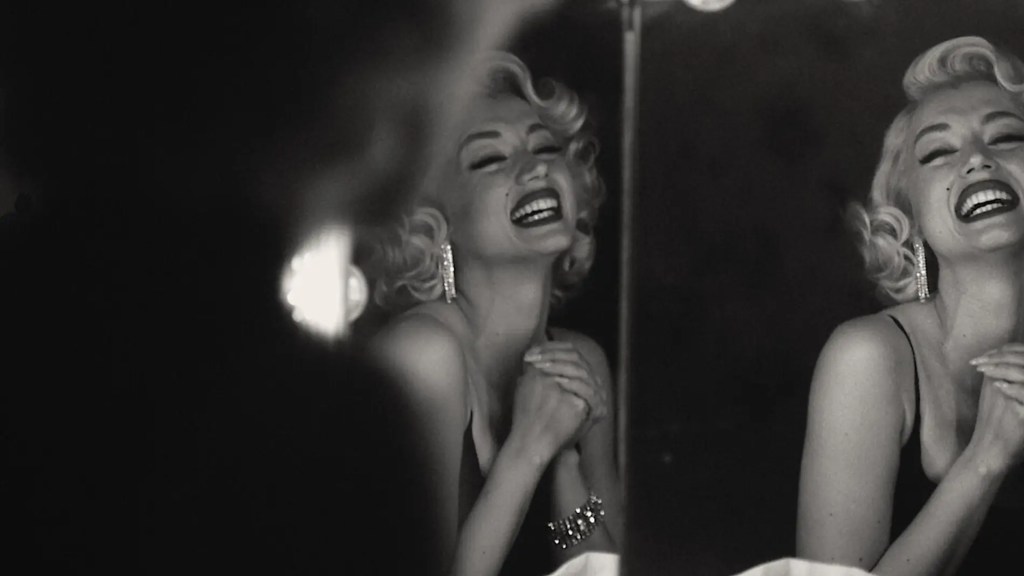
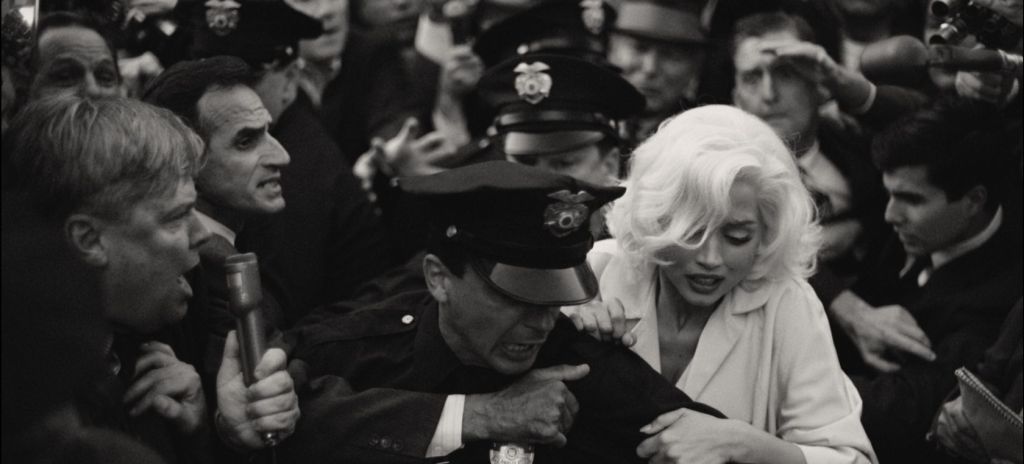
In what is a passion project for Dominik (the film is produced by his usual lead actor Brad Pitt), he has used Monroe’s life to make a visually enthralling film that grabs you by the throat from the get go, never letting you breathe for a second. Changing constantly between monochrome and color, Dominik’s direction is perfectly matched by the cinematography by Chayse Irvin, editing by Adam Robinson, and a score by Nick Cave and Warren Ellis to create a claustrophobic atmosphere more typical of a horror film. Moments like her first “audition” that violently descends into rape, and the abortion scenes encapsulate the fact that Blonde is at times less biopic than a scary tale of the darker side of fame. Actually, it is interesting to see how last year we saw Pablo Larraín’s Spencer -in which Kristen Stewart played Lady Di- is also closer to a gothic horror (albeit much less than Blonde, at least on a visual level) than to a dramatic and faithful portrayal of their lives.
It would be an understatement to say the film lacks a cohesive narrative, considering that it is constantly -and haphazardly- jumping between the different years of Monroe’s life, using these abrupt shifts in time to make us feel as discombobulated, anxious, lost, and saddened as Monroe feels. However, the disjointed storyline on itself should not be a problem -although the film might be seen as a compilation of scenes which sometimes are not actually connected as such-, the main issue with Blonde is that, by focusing mainly on the more tragic moments of her existence, it does not feel as a complete story, more like a misanthropic version of extremely damaging events (which are more or less accurate), as we leave behind her own personal and professional achievements and talent, thus reducing her to a victim instead of a fully fledged person – for the sake of a more provoking film.
Although Blonde is hard to watch, it is a worth watching film that, despite not portraying Monroe’s actual life accurately -reducing it to a number of scenes where the camera never shies away, surely leaving you with a sour taste in your mouth-, it showcases de Armas’ skills as an actress, in another biopic of a strong woman (like the aforementioned Spencer) who is not able to control her own narrative.
 The Neurotic Cinephile
You must be logged in to post a comment.