I remember reading somewhere that Francois Truffaut once said to the esteemed Gene Siskel -critic and Roger Ebert’s co-host in the show Siskel & Ebert & the Movies– that the most beautiful sight in a movie theatre was that of the light reflected from the screen onto the faces of the audience. It is a wonderful thing to take a peek at the faces of the strangers that surround you at the cinema and guess what effect the film is having on them. From the same film different people are going to experience totally different things. You can cry when watching a drama, or not; laugh when watching a comedy, or not; you can feel the chills going down your spine when watching a horror, or you can run to the lobby, unable to handle the fear.
It could be said that watching a film on your own, totally isolated from the rest of the world takes away part of the charm of cinema, as it eliminates the possibility of sharing and then discussing what you have just seen with a fellow viewer. This might allow you to view the film in a new light, to understand it better, discover something you might have missed -or just remember where you knew that actor from-. Sadly, having company is not always a good thing, as sometimes you can end up watching a film with one of those people who feel as if it is their duty to act as commentators and explain what is going all at all times and predict the next twist of the story -or ask you for information as if you had already seen the film and knew what was about to happen-.
Despite this, watching a film is an act of escapism in which we become part of the world inhabited by the characters on the screen. We are not aware that we have become part of a fictional reality; we do not realize that the hurdles that halt the progression of the central character concerns us more than the issues we had right until the projection started. Great films give the audience the possibility to leave their daily grind behind without needing neither medication nor meditation to do so. Give the audience a well made film with a great story and performances and, for a few hours, they will feel as if they have been hypnotized to forget what should be forgotten and exist in someone else’s shoes. Obviously, when I mentioned being hypnotized, I was being facetious, as nobody believes that a film can have such a powerful impact on someone’s mind, at least not as powerful as what we see in Bigas Luna’s Anguish.
Luna’s filmography is one of those that strongly opposes the use of the term categorization, as the late Spanish director made films of genres as different as historical (Volaverunt), thriller (Tatuaje), and slightly more difficult to pinpoint (Jamón, jamón; La teta y la luna or Son de mar). Amongst all of them, Luna made a -sadly- little-known film titled Anguish (Angustia), in which he, with the confidence and strength proper of a great filmmaker, played with the conventions of the horror genre mixed with a reflection on reality, fiction and meta-fiction.
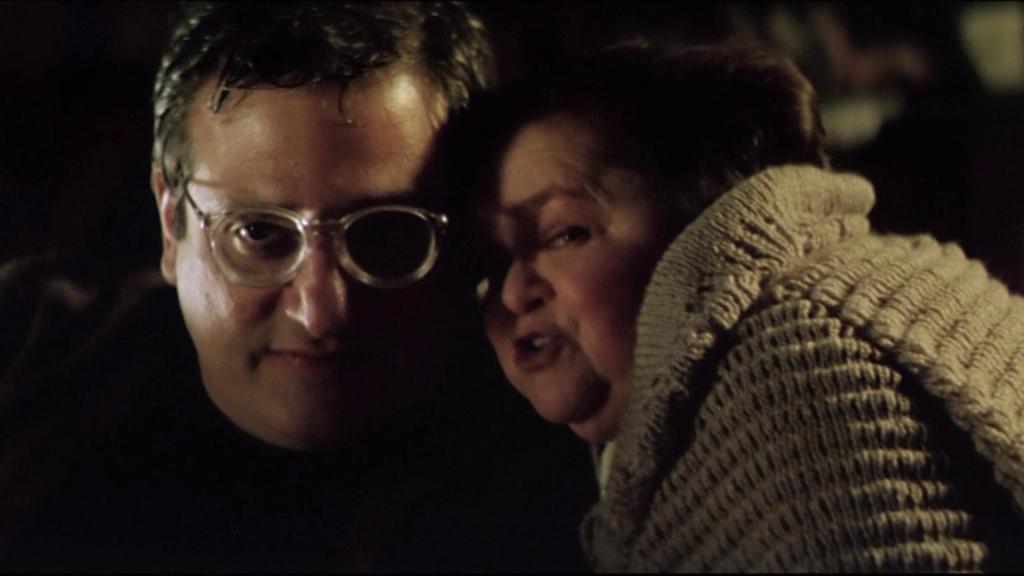
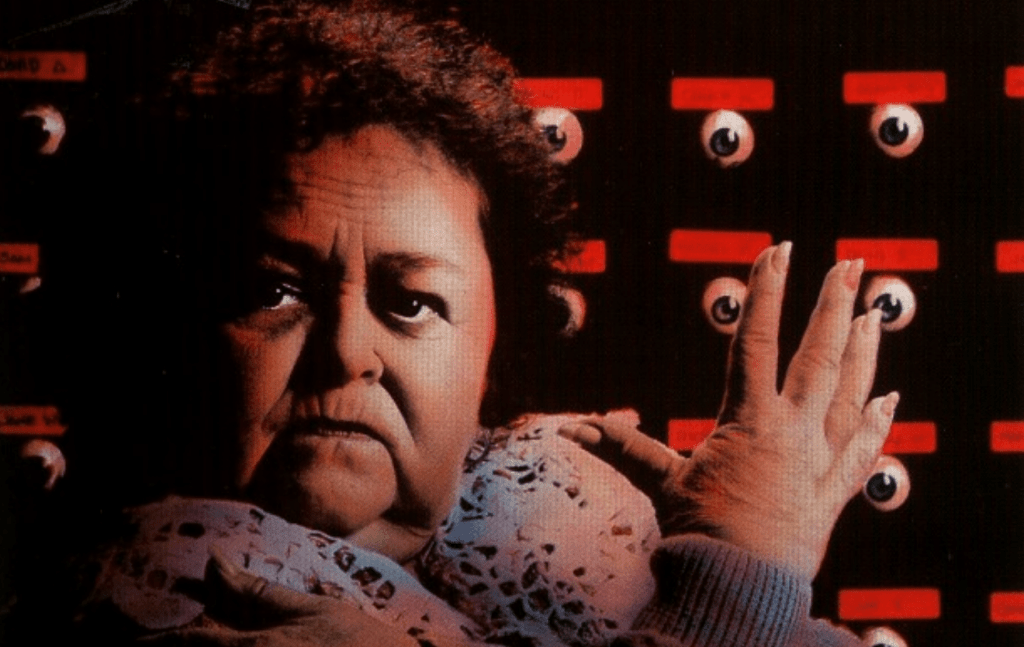
As soon as Anguish starts, we are thrown into the peculiar reality of John (magnificently played by Michael Lerner), an ophthalmologist’s assistant whose sight is deteriorating and his controlling mother Alice (the great Zelda Rubinstein). They seem to have an oppressive relationship that could make the one Norman Bates had with his mother feel like it belongs on a show like Modern Family. He is a meek man with an insane obsession for eyes and she is a woman who has such a tight grip on her son that she can control him to do anything she demands. And she does not send him to clean his room or make dinner, instead, she uses her power over him to send him on a killing spree to collect as many eyes as possible.
So far, up to this point Anguish seems like it has all the ingredients needed for a horror flick that might get lost in the myriad of similar films made in those days. However, Luna set off to make the film influenced by people like Hitchcock or Luis Buñuel, and his ambitions were bigger than making a nuts-and-bolts horror film. One of the ways in which Luna sets the film apart from others is by dedicating a good amount of time to set the scene. Despite the film not being in black and white, he uses a palette of sepia that gives a sense that the dimly lit flat in which John lives with his mother is set in a different realm, as if it were a place stuck in time, a place in which Alice can reign and use her powers on her son without limitations. Right at the beginning, after we have met John and Alice for the first time, we discover they share their home with a collection of caged birds and snails -representing a repressed freedom and sluggishness, respectively-. Then, a bird escapes and flies around the flat, just to get stuck behind a cupboard, leading John to rescue it with what seems to be a screwdriver while being constantly told by his mother what he should or should not to do. Here the bird works as an unpredictable violent interruption of their somewhat slow and sequestered life, life which is further destroyed later on when Alice accidentally steps on a snail and releases all the birds that fly crazily around.

Anguish is not a film that moves ahead at top speed, it purposefully moves forward slowly but with confident steps, as if it were a funambulist walking on a tightrope suspended on the void, thus emphasizing on Alice’s hypnotic powers over her son and producing a feeling of restlessness -and yes, anguish too- on the viewer. To achieve this, Luna has used an unsettling soundtrack -which constantly resonates in the back getting into your skin for the length of the film-, and also some imagery that links this film with some works of Luis Buñuel and Hitchcock. Firstly, taking into account that John gouges the eyes out his victims -an unpleasant act that is done in a way which might put some viewers away-, it is impossible to watch Anguish and not have in mind Buñuel’s Un Chien Andalou, and, like in the surrealist short film, it might be impossible to look away for some members of the audience, but more on that later.
In the case of Hitchcock, Luna joins the list of filmmakers inspired by the great director -something which seems slightly unavoidable given the relevance of the Englishman with the unmistakable profile-, and in Anguish we can see -apart from the fact that John and his mother are shaped after Norman and Norma Bates in Psycho- the influence of two of his most memorable films: Vertigo and Rear Window. In all the scenes in which Alice hypnotizes her son we see how Luna makes use of the same visual elements that appear in Vertigo, i.e., a spiral, the hair and the eye, images which bring to our mind the image of a circle, a figure which represents not only the power of John’s mother over him, but also a certain repetition and sense of being stuck in the same place sine die –something which is enhanced by the film when you notice that it starts and ends in the same way, with a girl screaming her lungs out-.
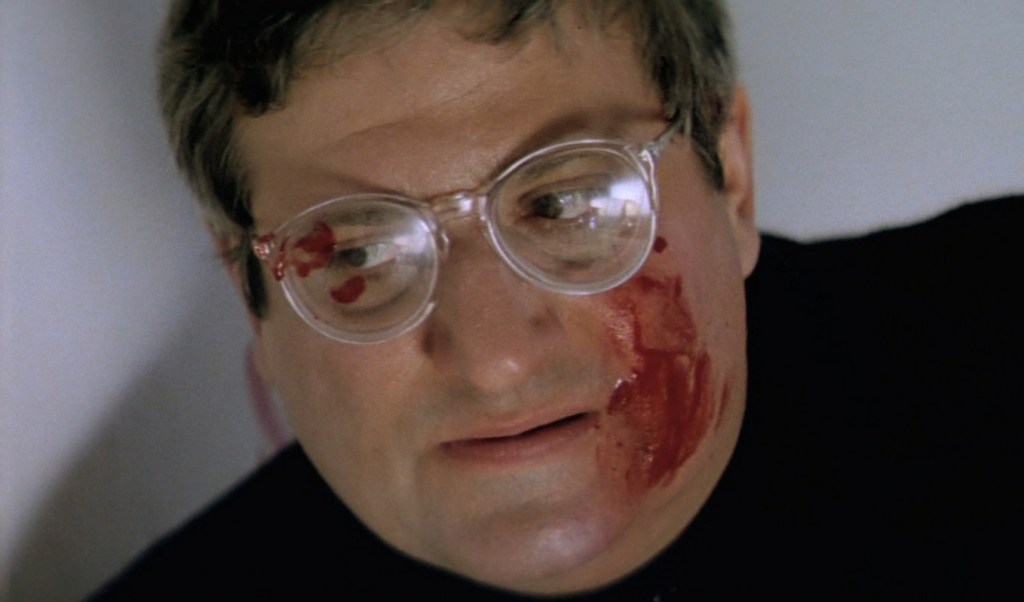
The influence of Rear Window is less evident, yet more important at the same time. In Anguish¸ Luna makes use of several close ups that enhance the claustrophobia in the viewer who feels trapped and unable to move, much like James Stewart’s character constantly looking through the lens of his camera, spying his murderous neighbour. Obviously, there are countless films that use close ups to recreate a similar effect, however, much in the same way as Hitchcock did with Rear Window, Luna uses these shots to reflect on how we look and to make a reflection on cinema which is further enhanced as the film progresses.
Before I continue, if you want to avoid a spoiler of the film and be surprised by what is left of Anguish, I recommend you to stop reading and come back to finish the review once you have seen the complete film.
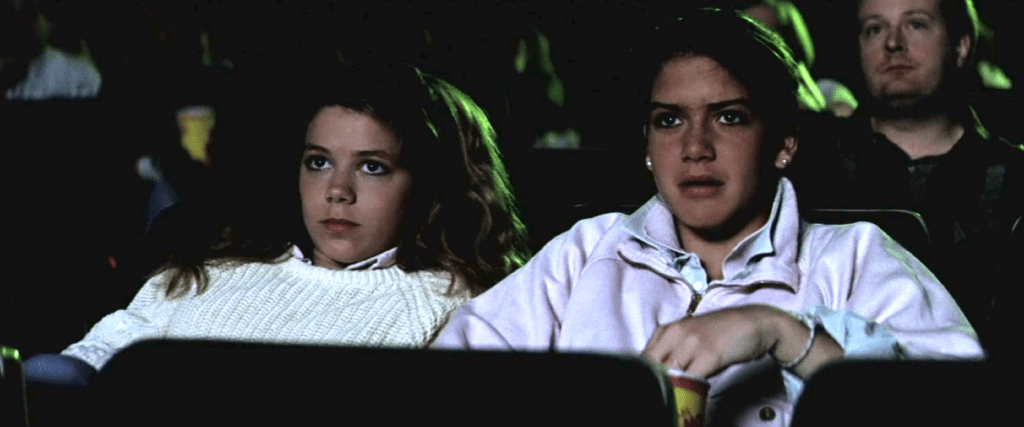
As I was saying before the disclaimer -one for a 34-year-old film, but a not very popular and easy one to find nonetheless-, Anguish makes a reflection on how we look at the same time that it contemplates the act of watching (either the cinema or others), and it does so by making us realize that the story of John, his mother and their killing spree is a film titled The Mommy and directed by Anul Sabig -ahem, Bigas Luna backwards, ahem- whose poster is a big manor portrayed in a way that brings to mind the Bates’ residence in Psycho. The Mommy –title which on itself is a pun as it resembles The Mummy whilst making us remember Norman Bates’ mummified mother- is being seen in a dark, crowded movie theatre in which we are witnesses of the reactions of the people sitting in the dark watching John on his mission to collect all the eyes of the city. Their reactions range from an apparent apathy, to joy, fear and even something that resembles a trance, which is experienced by a -somewhat creepy- man and is noticed by a girl -played by Talia Paul- who is anxious and is feeling more and more fidgety on her seat (next to her friend who is enjoying and munching her way through a bucket of pop-corn).
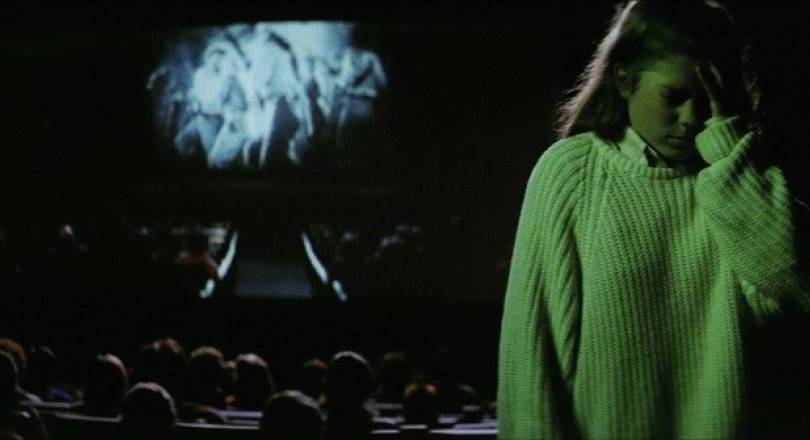
At this point, Luna has given us the keys to the kingdom, granting us full access to see three different levels at once. On one level we have the characters of The Lost World (film that John goes to see at the Roxy Kino cinema -but mostly to take the eyes out of its audience members-), on another the characters that accompany John -i.e., his mother and his victims- in The Mommy and, in a third level, the audience of The Mommy on the Rex cinema, place in which we discover that a man is starting to act in a way similar to John’s, probably as a consequence of Alice’s power. In addition to all those levels, we have to keep in mind that we are in a fourth level above all of them, watching a film (Anguish) that contains a film (The Mommy), which contains another film on itself (The Lost World). If it sounds confusing, is also because it is, as the strange man watching The Mommy starts to attack his fellow moviegoers at the same time that John is killing the audience of The Lost World.
Luna intentionally merges the stories, intertwining perfectly to bewilder the audience who sometimes does not know which film is watching. Probably with the intention of giving a human heart to the film, we follow the footsteps of Patty -the scared girl played by Talia Paul- who acts as a more relatable figure, one whose reactions to John’s acts and dread of what is to come are nothing but a reflection of what us -the real audience- might be feeling. In addition to that, she -and probably us too- has a hard time taking her eyes of the screen, which reflects on our fascination for watching something no matter how shocking, violent or distasteful it might be -not unlike with the scene in Buñuel’s Un Chien Andalou-. Furthermore, by having the possibility of seeing from the distance her reaction -together with that of the other moviegoers- we are given the chance of experiencing what a voyeur might feel gazing at someone in secret with none of the repercussions.
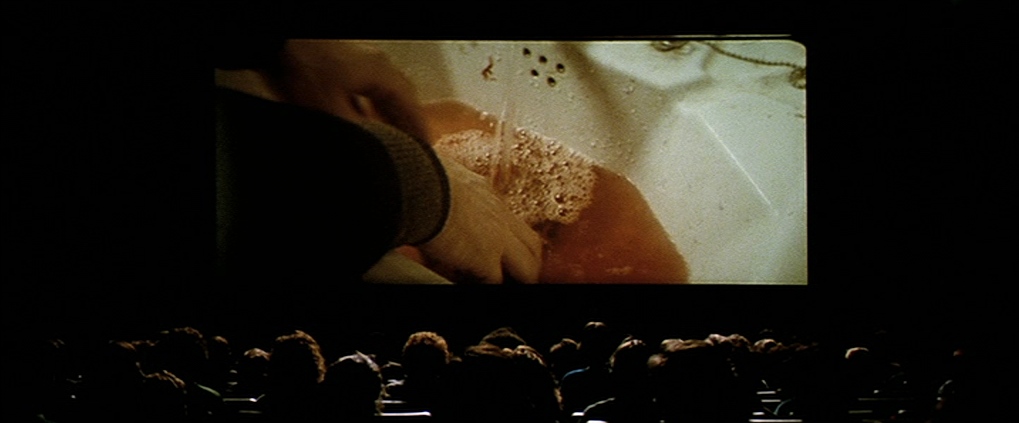
However, despite handling an exercise on metafiction with a combination of energy and panache, Anguish is far from perfect, as it deludes into a more conventional and less memorable film when it focuses on John (and by extension his imitator) killing people in a vicious and gory fashion which feels repetitive, not that original and might be too much for some audiences. Also, the film feels a little rough around its edges, which somewhat diminishes all the work done to create the different layers that co-exist and shape the universe of the film.
Although the film uses great performances by Lerner -whose ability to be perceived as vulnerable, lost yet menacing is outstanding- and Rubinstein -who uses diminutive stature and peculiar voice in a magnificently sinister way to exert her dominance-, to round off its originality and make you forget of some of its patchiness, it is Talia Paul -whose believable perfomance of the scared girl who cannot keep her eyes on the screen through the bloody scenes- the one that represents the anchor between the film and the real audience.
Thanks to her character we can fully understand that Anguish is more than a run-of-the-mill horror film, being instead a reflection on our desire to look at the lives of others and take a peek to see some shocking and ghastly acts from the safety provided by the darkness of the movie theater. Anguish is a film that arouses us to look, but the image we see is that of ourselves.
 The Neurotic Cinephile
You must be logged in to post a comment.