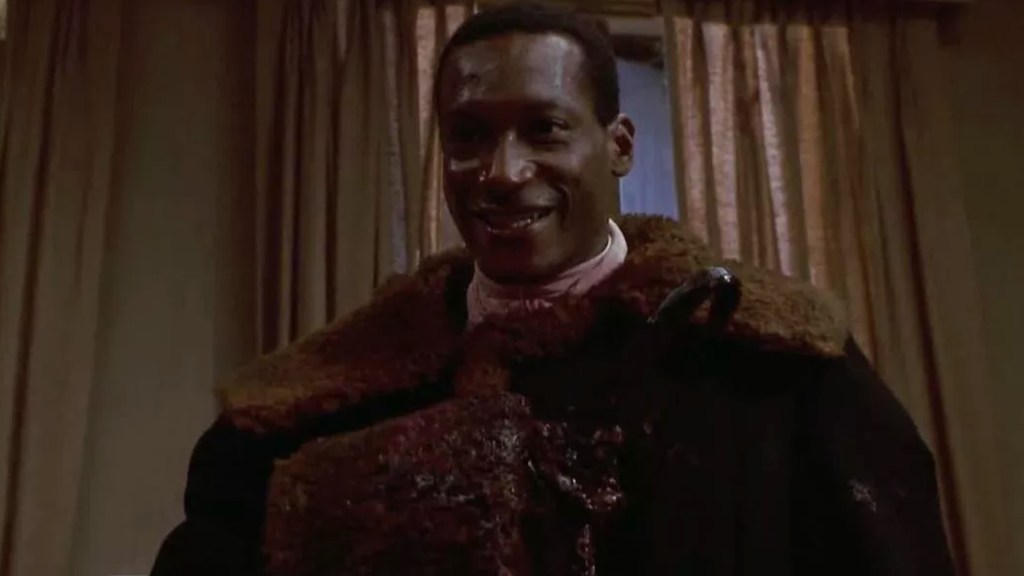
Despite several delays, a new take on the character of Candyman will finally reach the big screen. Directed by Nia DaCosta and produced by Jordan Peele, the new film will bring back Tony Todd as the eponymous character along with Yahya Abdul-Mateen II, Teyonah Parris and Colman Domingo. As the new version seems to follow the story that started back in 1992 and ignore its sequels -in the same way that David Gordon Green’s Halloween successfully achieved-, it would be an interesting idea to review the original film to see how it holds up.
Using Clive Barker’s short story The Forbidden as source material, Bernard Rose’s Candyman introduces the audience to Helen -Virginia Madsen- who is investigating modern urban legends with a colleague -played by Kasi Lemmons, director of Harriet-. As soon as they learn about the myth of Candyman, they decide to investigate further on the issue, starting with a trip to the poor neighborhood of Cabrini Green, where the killer has murdered a plethora of local residents, giving birth to a terrifying legend.
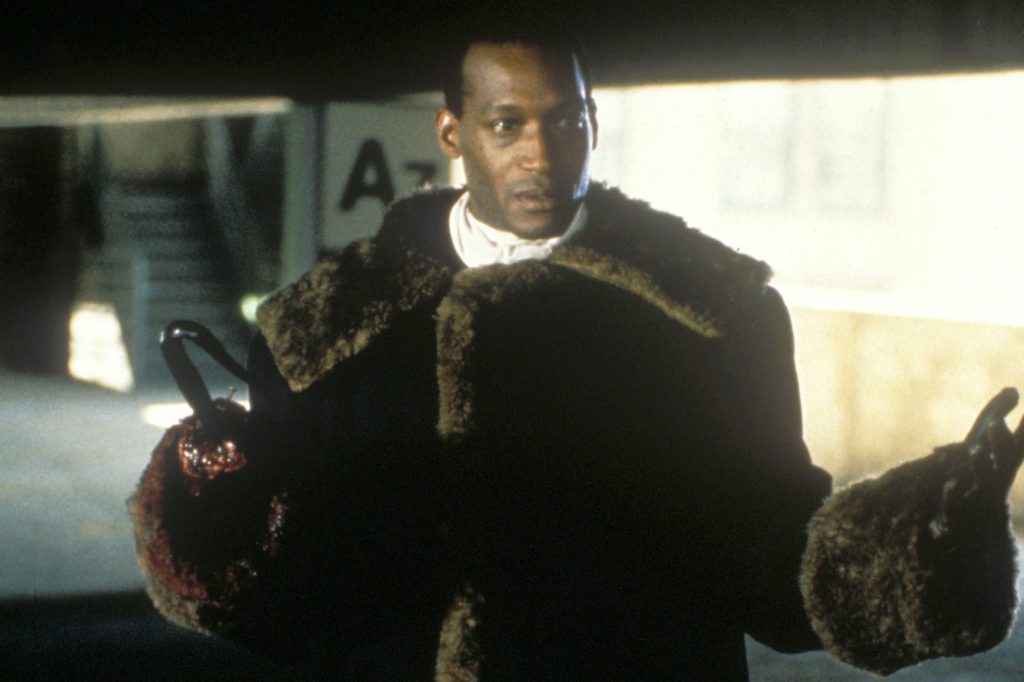
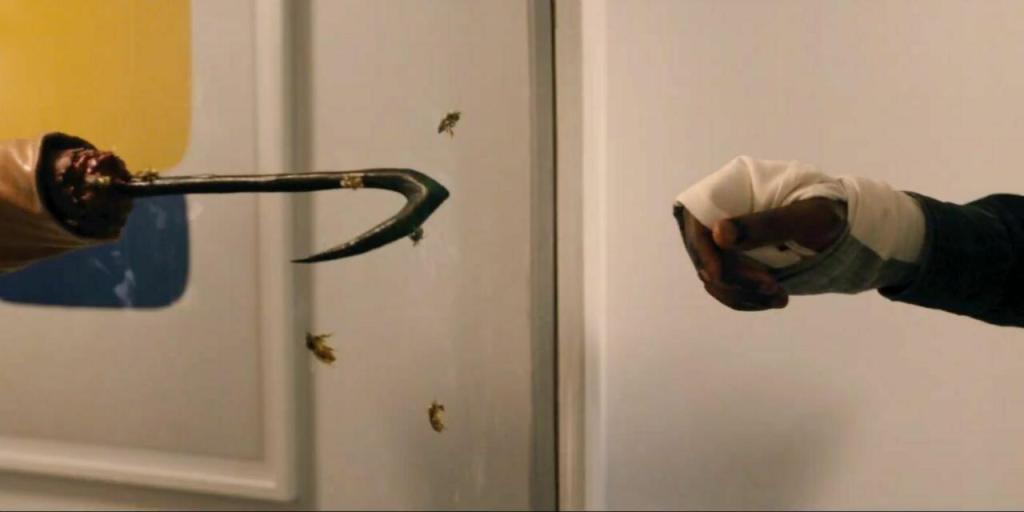
Great part of the film’s success lies on Tony Todd, but in order to understand the power of Tony Todd’s role as Candyman we might need a little bit of perspective. The concept of a powerful, immortal murderer on the loose, killing innocent people with a hook located where his right hand should be, is scary enough, although it could be said that it is not the most original, as a slightly similar character could be found in Wes Craven’s Nightmare on Elm Street, in which we are introduced to the unforgettable Freddie Krueger, who attacked teens in their sleep, though not with a hook but with a bladed glove. However, despite the apparently similar description of their characters, the similarities between Krueger and Candyman as characters are only few and superficial, as the performances could not be more different. Whereas in Nightmare on Elm Street -and its sequels- Robert Englund was the main attraction, playing Krueger as a flamboyant character who constantly grabs everybody’s attention, in Candyman, Todd’s performance is a complete opposite. Subtle, silent, constantly menacing -even when he limits his presence to only off screen whispers-, Todd never misses a beat -special mention should be given to the bees scene-, managing to be beckoningly intimidating in a way that still feels spine-chilling today. This is illustrated by the fact that -despite an all around new cast- Todd is reprising the role in the new film.

From the point of view of a horror film, Candyman ticks all the expected boxes that will satisfy fans everywhere -i.e. horrifying villain, jump scares, gory scenes…- and by its own merit it is a memorable entry into the genre -representing an excellent alternative to the slightly more popular Freddie Krueger, Jason Voorhes and Michael Myers-. However, what really makes Candyman stand out from the crowd of psychokillers is found in the exploration of the power of the stories we tell ourselves. Candyman, whose modus operandi (killing after the victim has said his name five times in front of a mirror) is inspired on the Bloody Mary myth, requires people to believe in his existence, to be afraid of him in order to maintain his legend alive. He has become a myth on Cabrini Green, where he is feared and part of the folklore, strengths that become weakened when Helen is attacked by a member of a gang who carries a hook on his right hand and Candyman’s legend starts to be questioned. At this point, Candyman’s aim is to do whatever it takes to restore his power, by killing as many people as possible in the process, and allowing us to explore the power behind his name and story at the same time.
Again, bringing back the character of Freddy Krueger, we may remember that he was a child killer burned alive by a desperate group of parents. Candyman (whose real name was Daniel Robitaille), on the other hand -no pun intended-, was the son of a slave, born in the 1890’s who made a living painting portraits until he fell in love with a white girl, who then became pregnant and whose father chased Robitaille, cut his right hand, poured honey all over him and let him to be stung to death by bees. Both Candyman and Kruger were set on fire, but the former’s ashes were scattered around Cabrini Green, a neighborhood from Chicago inhabited by people of color, who then became his main victims. The fact that Candyman wants people to be aware of his suffering, to believe in him, thus perpetuating his scary myth, could be analyzed as a necessity to never forget the existence of social inequalities, racism and their consequences. Although these issues are dealt with in the film, especially after Madsen’s character passes through a mirror and she starts to be part of another reality, another life she was not a part of before, we might find here what is probably the main weakness of the 1992 version of Candyman.

By giving a more prominent role to a protagonist that falls near the category of a final girl, who also belongs to a different social class and to a different race, the film misses an opportunity to further explore issues of racism, gentrification and social differences -slightly more present in Barker’s short story-. It is precisely because of this, that the upcoming film might have found its reason to exist. Despite ignoring its sequels, DaCosta’s film will focus on Anthony McCoy -played by Yahya Abdul-Mateen II- one of the surviving characters that appeared in the 1992 version of Candyman, who returns to his childhood neighbourhood of Cabrini Green, now completely altered and modernized, aimed at a younger -and probably more affluent- generation of residents. In this way, the new Candyman will, on the one hand, acknowledge the original film while, on the other, expand the story while establishing some interesting parallelisms -in the sense that McCoy is an artist as was Daniel Robitaille before he became Candyman- whilst dealing with racial issues head on.

Bernard Rose’s Candyman is a well made horror film that still feels relevant today and has stood the test of time somewhat unscathed, thanks in great part to a stellar performance by Tony Todd – that overshadows Virginia Madsen every time they share the screen- and an ominously wonderful soundtrack by Phillip Glass. However, despite being a worth-watching film, the prospect of the upcoming spiritual sequel is an exciting one, not only on the basis of a more thorough exploration of the racial inequalities, but also to discover a new take on the story from the promising Nia DaCosta and to see what Jordan Peele will bring to the table (only as a co-writer and producer) after the magnificent Get Out and Us.
 The Neurotic Cinephile
You must be logged in to post a comment.