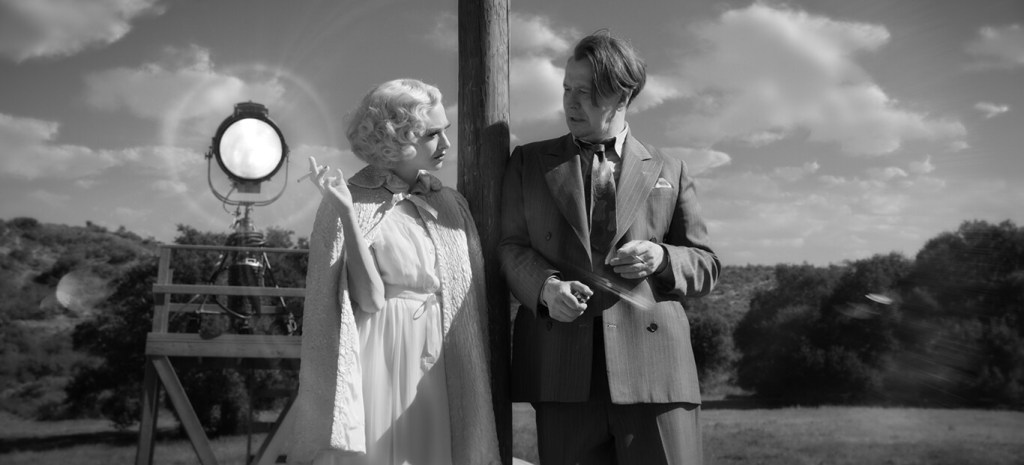
Directed by David Fincher and starring Gary Oldman, Amanda Seyfried and Charles Dance, Mank is centered around Herman J. Mankiewicz, in the middle of the creation of the script for Citizen Kane -whilst recovering from a car accident- and his past interactions with people like William Randolph Hearst and Marion Davies, among others, that served as inspiration for the story. Based on a script written by Jack Fincher (David Fincher’s late father) which the director of Se7en and The Fight Club had unsuccessfully tried to make for several years, Mank is clearly a testament not only to Mankiewicz’s talent, but also to a period of Hollywood (back then still called Hollywoodland) which has disappeared long ago.
Despite the nods to Citizen Kane for the eagle-eyed viewers -the scene in which Mankiewicz has to sit at an end of a table, reflecting the distance between him and Hearst in the same way that Welles did to show the growing distance between Kane and his wife, and one scene in which Mankiewicz drops a bottle from his hand in exactly the same way in which Kane dropped a snow globe-, Fincher has made the decision of losing some of the visual flamboyance that some of his other films have, in exchange for a filmmaking style much more traditional on its approach, giving the feeling that Mank could have been made eighty years ago. Furthermore, the film is gorgeously shot in black and white by Eric Messerschmidt -cinematographer of Gone Girl and Mindhunter- and has a wonderful period accurate soundtrack by Atticus Ross and Trent Reznor, both of whom also collaborated with Fincher on The Social Network, The Girl with the Dragon Tattoo and Gone Girl.
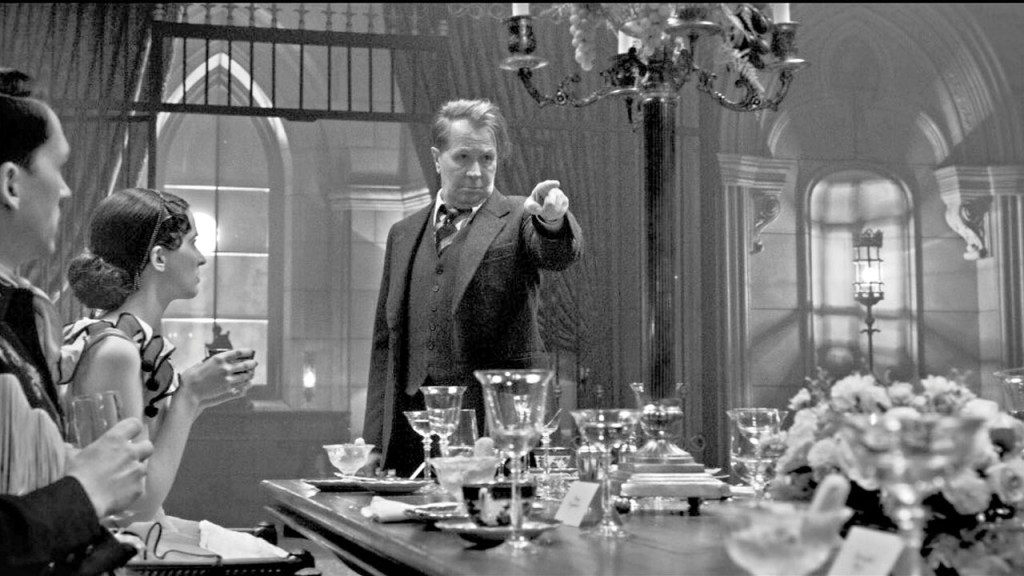
Taking on another real-life figure after his performance of Winston Churchill in Darkest Hour garnered him an Oscar, Gary Oldman manages to convincingly portray Mankiewicz as a self-destructive man who is used to being the smartest person in the room. Despite the fact that he does not resemble Mankiewicz, it is refreshing to see him act without the help of make-up or prosthetics. However, although Oldman’s acting is remarkable and does not reduce the character of Mankiewicz to a caricature of a drunken writer, it is Amanda Seyfried’s performance the one that steals the show. Seyfried has the charisma, talent and looks to convincingly portray Hearst’s lover, Marion Davies, in a way that not only makes you want her to have more and better roles in the future but at the same time gives the impression that she could have been the star of a plethora of films in the golden age of Hollywood. I wish Charles Dance had had a longer role though, as it is evident in the few scenes he is in, that his take on Hearst manages to be well-rounded, conveying a lurking sense of threat that is never fully explored.
However, most of Mank’s flaws come as a result of its own idiosyncrasies. First and foremost, the fact that the story is constantly jumping back and forth in time, does on the one hand allow us to understand the character and actions of Mankiewicz better, but on the other, gives a certain sense of watching a documentary that tries to analyze the figure of the writer by looking at specific moments in his life, thus simplifying his existence to a few key moments that have a direct connection to the present. Furthermore, it is undoubtedly true that Mank is a passion project for Fincher and, as it happened last year with Quentin Tarantino’s Once Upon a Time in Hollywood…, the resulting film gives the impression of being longer than it should have been, with some scenes that could be either unnecessary or meander more than they should, adding little to the general story.
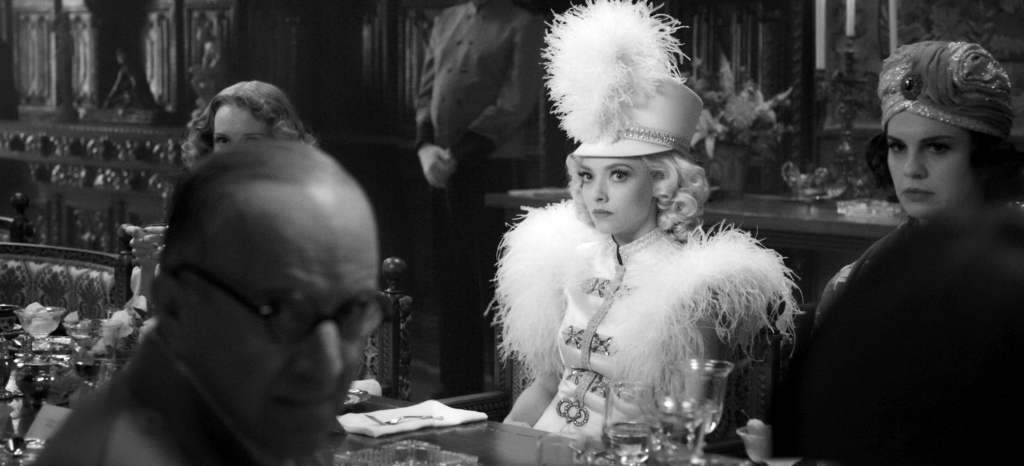
Finally, it has to be said that the fact that the idea that Mankiewicz was the sole writer of Citizen Kane -defended by film critic Pauline Kael and debunked long ago as a criticism to the author theory-, reduces the presence of Orson Welles -well played by Tom Burke- to a mere handful of scenes, instead of a more relevant character in the story behind the creation of what is generally considered as the greatest film of all time.
All in all, Mank is not Fincher’s best effort to date, however, not because it is supporting a theory that might not be one hundred per cent accurate and because it could be slightly longer than it should have been. The film is a love-letter to a time in which script writers were stars and studios were starting to realize their own power (for better or worse), it is a time that sadly has already passed, and it is this openly nostalgic look at the past which gives the impression that Mank is a fish fighting against the current, not yet realizing that it is out of the water.
 The Neurotic Cinephile
You must be logged in to post a comment.