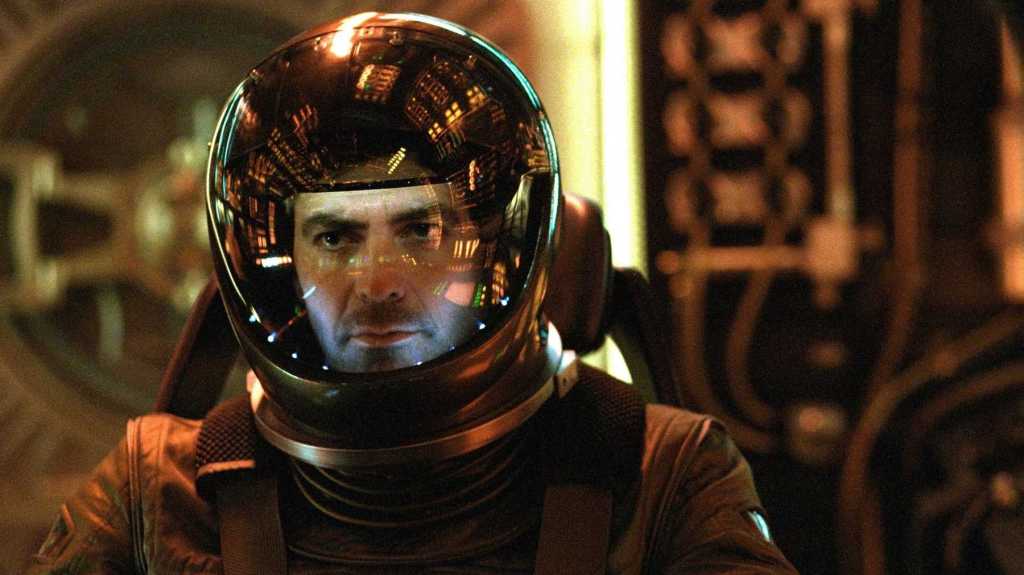
By the end of the 1990’s and start of the 2000’s, George Clooney had made a name for himself in the film industry. He exuded a combination of effortlessly charming elegance, talent and charisma in ER -show that put him on the map for a wider audience-, and films like Three Kings, The Perfect Storm and Ocean’s Eleven. Let’s pretend that Batman and Robin does not exist, shall we?
Despite his popularity, he seemed adamant to prove that he was more than yet another leading actor, whose career could vanish with his looks, by starring in O Brother, Where Art Thou?, the first of his four collaborations with the Coen Brothers, and in 2002 not only he debuted as a director in Confessions of a Dangerous Mind but also worked again with Steven Sodergbergh in Solaris.
However, despite the fact that Solaris was produced by James Cameron, who is one of the most relevant names of the world of science fiction, the film is not an ambitious sci-fi picture, but clearly the result of the vision of the man behind the camera, Steven Sodergbergh.
Sodergbergh’s Solaris is the third time that Lem’s novel has been adapted to the screen -the other times being in 1968 as a tv movie and by Andrei Tarkovsky in 1972-, nevertheless, despite using the same plot in general terms, Soderbergh -also author of the script- altered the focus of the story, much to the dismay of Lem himself.
The Polish author manifested his dislike of this film basing his opinion on the fact that the focus of Soderbergh’s film was on the relationship between the central characters -played by Clooney and Natascha McElhone, and not on the encounter with an alien species, Lem’s original intention.
Despite Lem’s reasonable opinion, the fact that Sodergbergh decided to focus the story on the dynamic between the characters of Kelvin and Rheya (anagram of Harey, her original name in the novel) is what makes this film different from the other adaptations, besides, a much better film that it could otherwise have been.
Life has changed -for better or worse- since Lem’s novel first saw the light of day. The fascination with the exploration of the confines of the galaxy which innundated society in the mid of the past century has been left behind. Gone are the years of the Space Race in which everybody was curious about what lies beyond the clouds, perhaps due to the fact that our collective inquisitiveness about the unknown has been satisfied.
Although Sodergbergh’s filmography is filled with a melange of genres, choose any of his films and, since the very first scenes, it will be evident that what you are seeing is a film made by a director interested on experimenting with a raft of styles going from more -apparently- straightforward –Sex, lies and videotape, The Limey, Erin Brockovich, Side Effects or Un-sane (shot on an iPhone)-to more exuberant and playful -like the Ocean’s Eleven saga, Magic Mike or Behind the Candelabra- and Solaris is no exception to that idea.
It is clear from the get-go, as we see a somber Clooney in his job as a psychologist in his office or walking around an faceless city under the rain, that Soderbergh has taken a low-key approach to the sci-fi genre, making it with an approach and style closer to an indie film than a sci-fi epic.
The fact that the length is only a mere 98 minutes, is by no means an issue, as Clooney’s Dr Chris Kelvin has already arrived at the space station before the first 10 minutes, right after being summoned by his scientist friend Gibrarian to investigate some strange events that have struck the crew aboard said station.
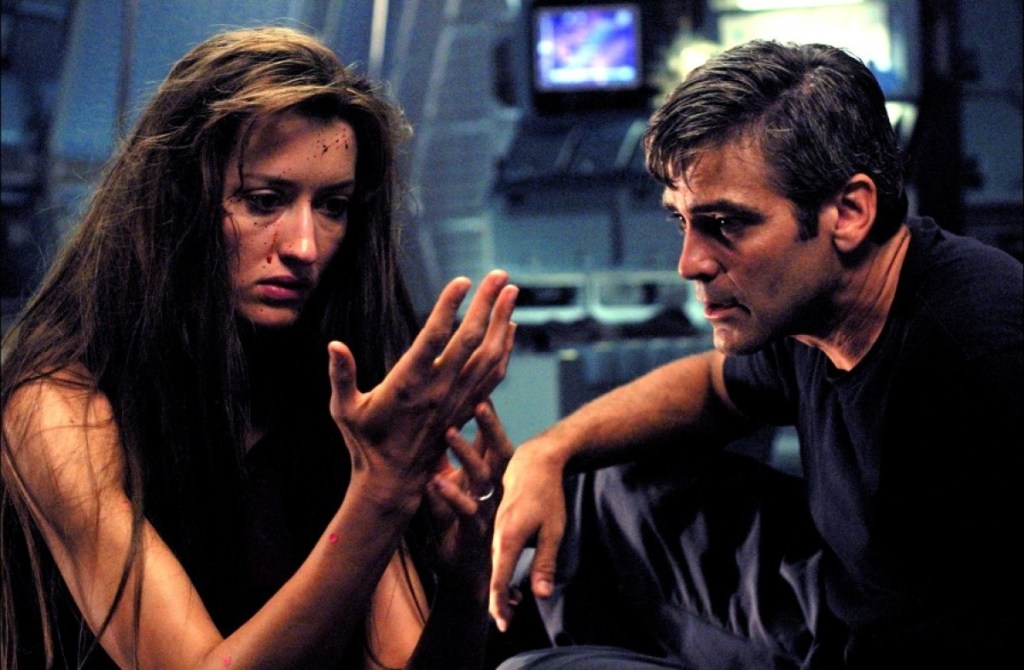
However, he then starts to suffer the same symptoms as the rest of the crew and it is at that moment, marked by the apparition of Natascha McElhone’s character, when the film veers off from the consequences of the exploration of the outer space to a study of the inner self.
As we start to see flashbacks of different moments in their life as a couple, it becomes clear that the story about studying the consequences of the discovery of the hidden corners of the galaxy is nothing but a MacGuffin to study not only love, but also about choices, forgiveness and resolution.
More in the vein of pictures like Robert Zemekis’ Contact or Denis Villeneuve’s Arrival, Solaris might not be a typical sci-fi film, but it was never intended to be so. The classical image of the protagonists contemplating the cold and infinite galaxy does not apply to this film, as their minds and hearts are still on earth.
 The Neurotic Cinephile
You must be logged in to post a comment.