I sat down to watch Rebecca feeling slightly cautious, as I am a fan of Ben Wheatley’s previous works, and the fact that my first impressions from the trailer made me thing that this seemed like a step aside from his traditional, smaller, left-field films like A Field in England, Kill List, Sightseers or Free Fire. It also goes without saying that those who compare themselves with Alfred Hitchcock, have remade his films, or try to emulate him and his style are doomed to be overshadowed by the master of suspense… maybe with the possible exception of some Brian de Palma’s earlier films like Obssession and Body Double.
Furthermore, the fact that remaking films has stopped to be a trend and become an established tradition did not help at all, as I could not stop thinking that there is no need to remake a classic like Hitchcock’s 1940 adaptation of the novel written by Daphne Du Maurier, creator of masterpieces also adapted to the screen as Hitchcock’s The Birds and Nicolas Roeg’s Don’t Look Now.
However, despite all the hatred that we might have against remakes on the basis that a vast majority of them have no purpose, as they might bring nothing new and sometimes they are completely unnecessary, some of them could be considered as superior to the original -take John Carpenter’s The Thing and Phillip Kaufman’s Invasion of the Body Snatchers for instance-.
As I had Rebecca paused in front of me with the Netflix logo shining in front of my eyes I told to myself that no remake -good, mediocre or bad- has made me change my mind in relation with the original, and with a slightly more positive outlook and firmly convinced that I was going to watch the film without comparing it with the 1940 film, starring Laurence Olivier and Joan Fontaine, and evaluate it by its own merits, I pressed play.
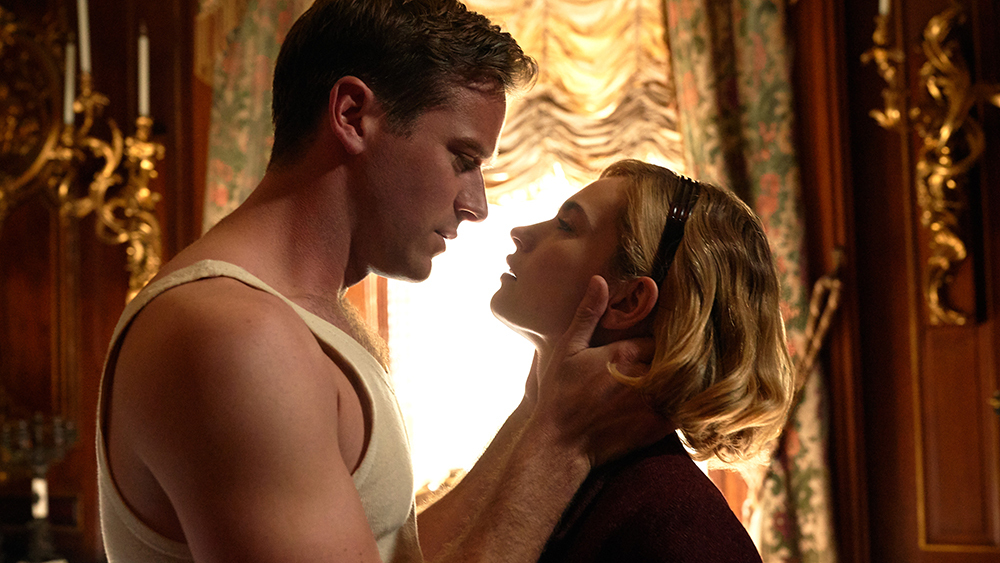
As attractive as its protagonist duo -played by Lily James and Armie Hammer, the latter also appeared in Wheatley’s Free Fire-, Wheatley and his usual cinematographer Laurie Rose make the most of the locations to create a visually gorgeous film, that as the story progresses and the protagonists move from the sunny and glamorous Montecarlo to Manderley (and the surrounding locations) and its grayish and gothic character, the film goes from being lively and colorful to mysterious and darker.
Due to the changing nature of the plot -the script is co-written by Jane Goldman, Joe Shrapnel and Anna Whitehouse-, the film sometimes changes its style from a by-the-numbers romantic film, to a courtroom drama, while also occasionally flirting with gothic horror. It is perhaps the fact that we might be able to sense Wheatley’s intention to push the film into a more horrifying territory which is never fully explored that leaves a feeling of an opportunity being wasted.
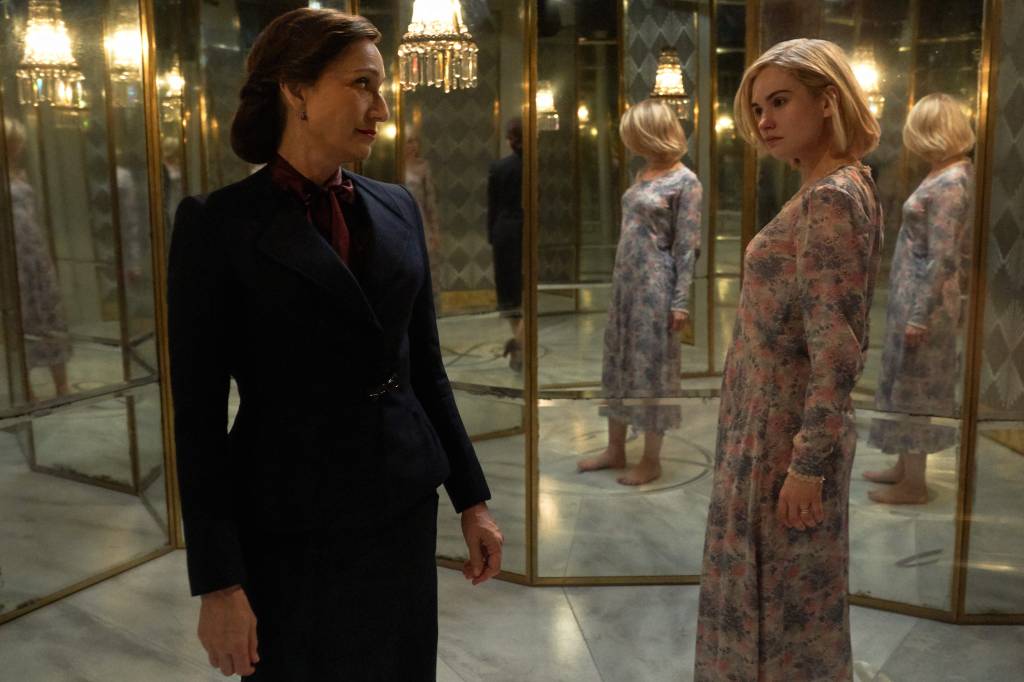
It is certainly a shame that Rebecca stops right before exploring some of the darkest conceits of the story, as not only there is talent behind the camera, but also in front of it. Both Lily James and Armie Hammer are good, portraying the different sides of their characters, but sadly for them, they are both outperformed by the magnificent Kristin Scott Thomas playing the intimidating and manipulative Mrs Danvers. Stealing every scene she is in with malevolent elegance, and leaving you desiring her to be back to chew the scenery once more, Scott Thomas quickly becomes the best part of the film.
While on the surface Rebecca, might seem as a change of direction for Wheatley who seems to be playing it safer than in other entries in his filmography, it is not necessarily a bad thing. On its favour, the film manages to be visually attractive, well directed, has good performances -apart from the aforementioned Scott Thomas, Ann Dowd, Sam Riley and Keeley Hawes are also worth mentioning- and an excellent soundtrack -with the fitting Let No Man Steal Your Thyme by Pentangle as the most memorable of all the pieces-.
However, it must be said that the biggest flaw of the film is that it is too safe for its own benefit. It never attempts to be bold, different, or to explore fully the potential of the more horrifying and psychologically spine-tingling moments of the story. Perhaps, by having Wheatley taking care only of the director’s duties, and not being responsible of the script (with his frequent collaborator and partner Amy Jump) feels like a wasted opportunity to explore from a psychological perspective the horror and the unexplainable -see A Field in England which is worth mentioning only for the tent scene itself-, and what is worse, it also feels slightly like a waste of his talent.
P.S. There is not a trace of Michael Smiley, and that is an issue that should have been avoided.
 The Neurotic Cinephile
You must be logged in to post a comment.