Plentiful are the adaptations of Stephen King’s works. There are masterpieces like The Shawshank Redemption, The Green Mile and The Shining and less-than-good films like Cell, The Dark Tower, Dreamcatcher or The Lawnmower Man, all of that proving thatthere is no doubt about the fact that King’s stories are perfectly suited to being converted to the screen -not only the big one, but also in the small screen with shows like Mr. Mercedes, Under the Dome and recently The Outsider-.
Without an apparent shortage of adaptations in the near future, we have seen remakes of King’s works (Carrie, IT, and Pet Sematary) and films being adapted as tv shows (The Mist). However, if there’s a film that has, thankfully, not -yet?- being considered for a remake, is Misery.
Directed by Rob Reiner, Misery is the second time Reiner made a film using a story by King as the source, as he directed in 1986 the wonderfully charming Stand by Me, based on King’s novella The Body. In Misery, he used a script written by William Goldman, with whom he previously collaborated in The Princess Bride -written by Goldman as well, based on his own novel of the same title-.
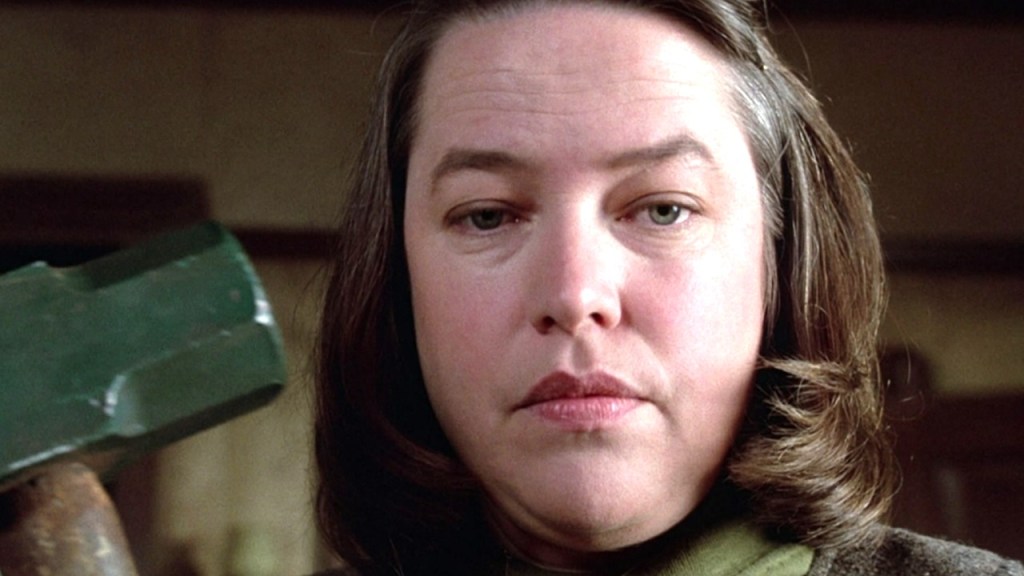
With a great combination of talent behind the camera, Misery stars Kathy Bates as Annie Wilkes, an awkward, innocent looking nurse who rescues a well-known novelist, Paul Sheldon -played by James Caan-, after he has suffered an accident on his way home after finishing his latest manuscript on a secluded location in the mountains of Colorado. From the moment he is rescued by Wilkes, we start to suspect that not everything is what it seems. It is not possible for a person to be as nice and caring as Wilkes proves to be. Sure, there is a lot of snow outside, but there must be a way for Sheldon to go to a hospital or to his own home.
Things start then to go cuckoo with the same precision of a Swiss clock. Sheldon starts to wonder if there is any way for him to contact anybody outside the room in which he is starting to find himself trapped. And Wilkes, whose favourite author is non other than Sheldon, shows how devoted she is to his talent, as well as her inability to control her anger, resulting in sudden outbursts, which culminate when she discovers the ending of the manuscript which will put a conclusion to her beloved saga of romantic novels. Disappointed and raging with desperation, Wilkes then forces Sheldon to re-write the whole book once more, though this time with a more satisfying outcome.
At this point the film becomes an intense battle between the -now officially- trapped Sheldon, and the maniac Wilkes. We as audience are almost as confined to the room as Sheldon, which magnifies and makes us experience the same level of anxiety that is running through Sheldon’s mind. We fear every time Wilkes abruptly opens the door, every time she enters the room. Thanks to the precise close ups, we feel our personal space invaded by the brutish nature of Bates’ central character. However, due to the magnetic nature of her performance, and her charisma, secretly we expect her to enter the room again as soon as she has left it.

Some audiences might be put off by Misery due to the strong sense of being watching a stage play that permeates the majority of the film. Maybe some people can even be put off since the film is apparently shot with a simplistic style by Reiner without any flamboyant special effects or exotic locations. Possibly, the lack of a larger cast can be another issue to have with Misery, since, most of the film plays around the central duo.
However, none of these concerns hinders the film, quite the opposite, actually. Misery is an electrifying, heart-stopping ride that puts you right in the centre of the action. It is a horror film whose strength relies on its depiction of madness as well as on the belief that Wilkes is terrifying enough to send chills down anyone’s spine. And if Misery is as successful as it is, is mostly due to the performances of both Kathy Bates and James Caan.
The strongest point of Misery is its central performances. However, before mentioning Kathy Bates, kudos should be given to James Caan. Otherwise seen in films portraying tough, temperamental, hot-headed roles, here he successfully gives a performance that is as restrained as his character finds himself plenty of times.
Thanks to Caan’s understated work, who successfully shifts between fear, hope, sadness and anger without saying much -sometimes only with a look on his face-, the contrast with a praiseworthy, over the top, swinging-for-the-fences performance by the glorious Kathy Bates makes the viewing experience even more captivating.
Great part of the success of Misery is due to Bates’ portrayal of Annie Wilkes, a character, who jumps from a sweet yet slightly odd woman nursing her favourite author, to a deranged psychopath willing to do anything just to have the perfect ending for her beloved saga of novels.
It is difficult to think of another actress as Annie Wilkes. In a role that -in less capable hands- could have been an almost parodic performance, Bates proves more than able to succeed at anything that the script throws at her. She is able to be, innocent, dark, funny, scary, sweet and brute, not only in the whole film, but sometimes within the same scene.
It is then a no brainer that she received the Oscar for Best Actress on 1991, as thanks to her talent, not only Wilkes is portrayed as a fully-fledged character but also is considered as one of the most memorable villains in film history.
It is no matter, then that the supporting roles -the magnificent Lauren Bacall as Sheldon’s literary agent and Richard Farnsworth giving a necessary warm blanket of a performance- are so small, since once the story starts firing on all cylinders, you do not want to take your eyes off of the protagonist duo, being completely submerged in the story.
Misery triumphs perhaps not only thanks to the actors’ talent and stamina, but also thanks to its commitment to portray the story with only the essential elements to succeed. A well-written, focused script that avoids some of the excesses of the original novel by Goldman; and a good straightforward, direction by Reiner that does not get in the way of the actors, therefore reinforcing the film’s tension.
By bringing a realistic, minimal approach, putting horror right in the centre, Misery not only acts as a counterpoint to the excesses of Stanley Kubrick’s The Shining and the more unrealistic elements of Gerald’s Game -directed by Mike Flanagan, based also on a novel by King-, but also, it manages to be the perfect complement to them, as it is also centered around a character trapped, who faces an almost certain death, but could also be interpreted as a study of people unable to escape from the consequences of their decisions and move on with their own lives.
 The Neurotic Cinephile
You must be logged in to post a comment.