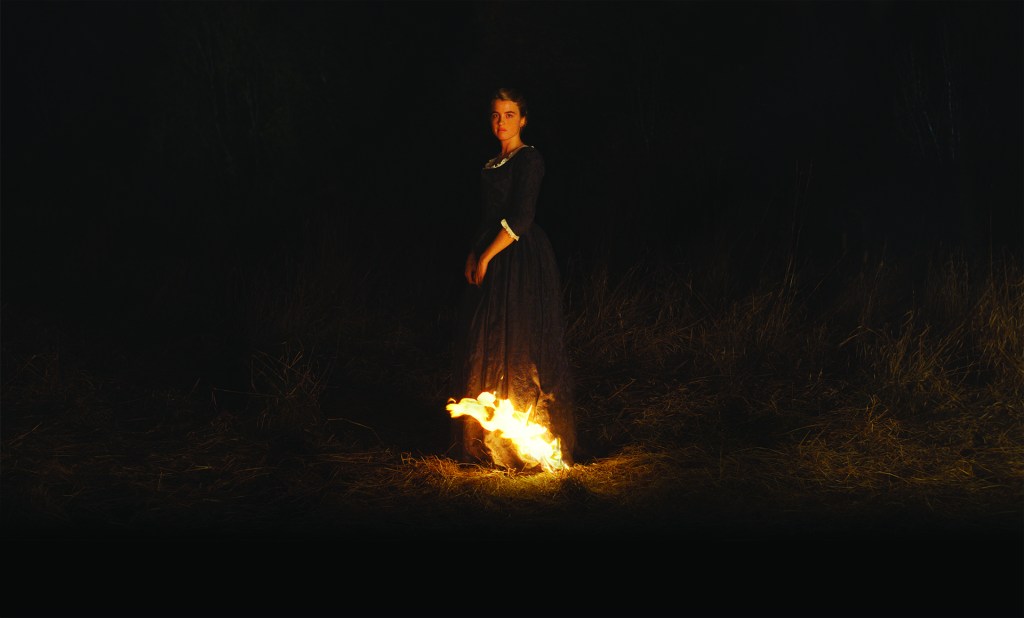
At the beginning of the story -written also by the director, Céline Sciamma (Tomboy, Girlhood)-, set on the XVIIIth century, we are introduced to a melancholic Marianne (Noémie Merlant), posing for her pupils, herself now the object of a portrait. It is after we see a painting that recreates the image that gives title to the film -a woman with her dress catching fire- that the film jumps back in time to the trip made by Marianne to an island with the aim of painting a wedding portrait of Héloïse (Adèle Haenel), after the previous painter left the task unfinished.
Héloïse’s refusal to have her portrait made is a reflection of her opposition to her arranged marriage to an Italian man which causes Marianne to act as a chaperone, walking alongside her during the day, secretly observing every movement, gesture, look on her face in order to finish the portrait without her acknowledgment.
The concept of giving the audience the possibility of watching a person without their knowledge has been explored in cinema umpteenth times, so many in fact that it is difficult to select only a few examples, coming first to mind Hitchcock’s Rear Window or Psycho, Coppola’s The Conversation and de Palma’s Dressed to kill, Blow Out and Body Double. Nevertheless, something that sets Portrait of a Lady on Fire aside, is the fact that here we are looking though the eyes of a woman. An example of this shift in perspective is clearly stated when we discover that Héloïse’s first portrait was left unfinished by a male painter after her refusal to pose.
The consequences of this shift in the way we look at the characters are evident in the delicacy with which we explore and consequently discover who they really are -sublimely represented in a scene in which they describe to each other the way they behave and the small unconscious gestures they make when they experience feelings like embarrassment or anger- and also in the scenes that are shown to be observed.
There are no lingering shots to the female body, or to private moments of a more erotic nature, in contrast we are witnesses of scenes ranging from a game of cards in the kitchen to an extremely private sequence dealing with the issue of abortion in such a direct manner that one of the characters decides to take her eyes away.
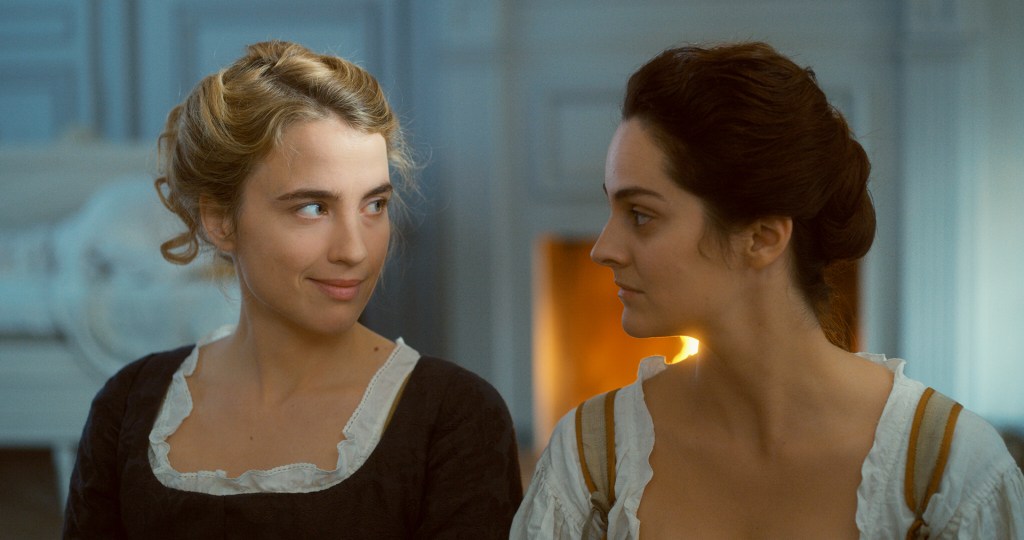
It is precisely this idea of taking your eyes away from what is happening in front of you that, as a viewer seems preposterous. Portrait of a Lady on Fire puts you in the centre of the story thanks to the use of imagery -there are shots that would not look out of place in a gothic tale-, scenery -gorgeously contrasting the enclosed domestic spaces and the open landscape that surrounds the island in a way which could bring to mind the setting of stories like Emily Brontë’s Wuthering Heights-.
Furthermore, the tactile aspect of the film, together with the importance given to sounds, despite the fact that -except for the gorgeously exhilarating scene in which a group of women breaks into song around a bonfire and the beautifully emotional final scene- it is almost devoid of a soundtrack, makes it difficult not to feel captivated by the intimate atmosphere crafted by Sciamma that can even allow you to feel the paint in the protagonist’s hands.
Portrait of a Lady on Fire represents a perfect contrasting companion to the tradition of films constructed around the notion of secretly observing the other. However, the film does so much more than that. Sciamma has managed to craft an engrossingly tasteful masterpiece that manages to keep your eyes constantly gazing at the screen and act as “a manifesto about the female gaze”, which hopefully might change the perspective of how we behold the life of another person.
 The Neurotic Cinephile
You must be logged in to post a comment.